
“Recasting Turandot: Daughters of a Disputed Land” by Cleo Roberts-Komireddi
Drawing on the myth of the Slavic princess Turandot, Parasol unit’s collateral event in Venice examines empire, migration, and the burdens borne by women.

“The Exhibition Reframing Turandot’s Story at the Venice Biennale” by Jacopo Nuvolari
Presented during the 61st Venice Biennale, TURANDOT: To the Daughters of the East reinterprets Giacomo Puccini’s Princess of Ice as a symbol of autonomy and resilience through the work of eleven female artists.

“Can art triumph in a Venice Biennale marked by protests?” by Jackie Wullschläger
Palazzo Franchetti’s Turandot: To the Daughters of the East celebrates 11 wildly imaginative women artists exploring history and modernity in central Asia and the Middle East

“Parasol Unit returns with a showcase of women from Central Asia and beyond” by Aimee Dawson
The non-profit London space, which closed in 2020, enters a new era at the Venice Biennale with an exhibition of 11 female artists.

“Sketchbook: Afruz Amighi ’97” by Nicole Anderson
The Brooklyn-based sculptor on how architecture, light, and everyday materials inform her work.

“Comparative Hell: Arts of Asian Underworlds” by Ann McCoy
In an age when few dread eternal damnation and the torments of hell no longer function as a deterrent to bad behavior, a stunning exhibition at the Asia Society Museum expands our knowledge of this infernal nether region.

“At These Exhibitions, Death Is a Lively Subject” by Laurel Graeber
Museums are showing art from across the centuries that tackles core questions, through religious and secular lenses, about what happens when we die.

Comparative Hell: Arts of Asian Underworlds at Asia Society
A look at "Comparative Hell: Arts of Asian Underworlds" on view at Asia Society Museum.

‘Comparative Hell: Arts of Asian Underworlds’ Review: Fiery Eastern Afterlives” by Lance Esplund
Ranging from the eighth century to the 21st, a show at Asia Society Museum displays Eastern art’s dazzling depictions of the infernal regions.

“Spaces of Possibility with Iranian Diaspora Artist, Afruz Amighi” by Peppa, Center Research Fellow, New York
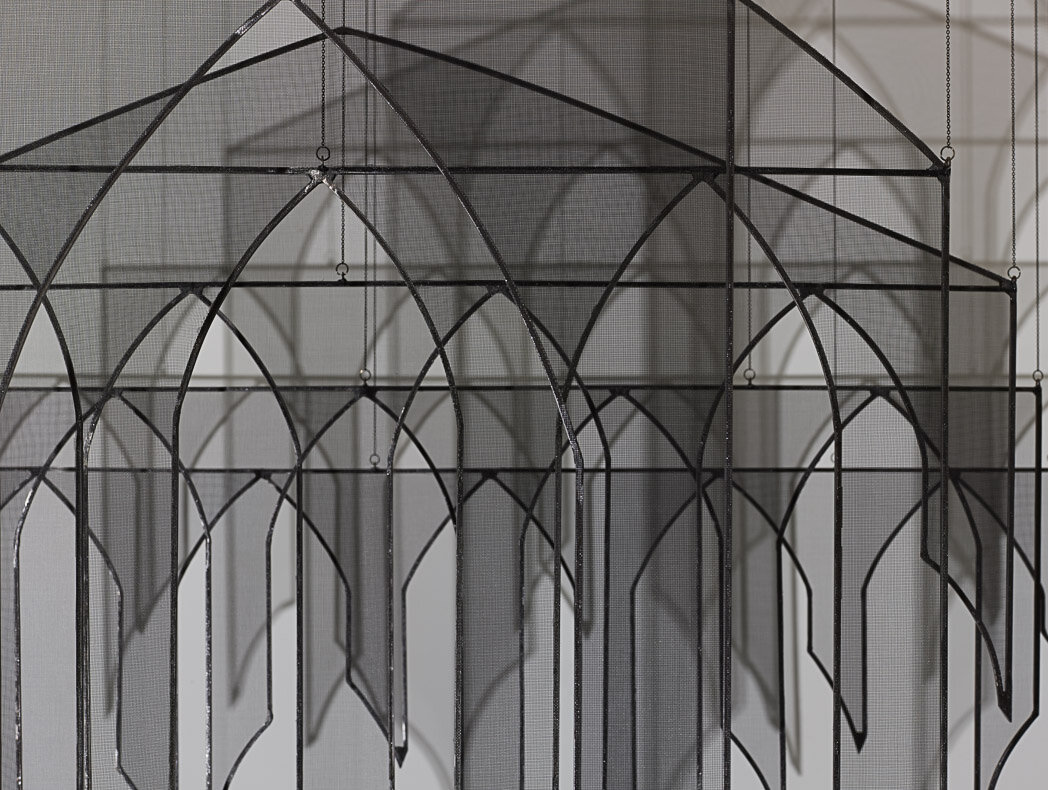
Most renowned for her seemingly weightless sculptures made of steel, chain, and light, artist Afruz Amighi creates artwork using beautifully ornate Iranian-inspired aesthetics to reimagine connotations of materials and form.

“Contemporary Iranian Art That Doesn’t Shy Away from Politics” by Ksenia M. Soboleva
One of the most instantly captivating pieces, Afruz Amighi’s installation “Angels in Combat I” (2010), beautifully exemplifies what seems to be a central thread tying many of the artists together: the appropriation of traditional Iranian decorative strategies to convey political metaphors.

Meet the Artist: Afruz Amighi
Afruz Amighi is a sculptor and installation artist whose installations use a subtle play of light and shadow.

“The Quietly Rebellious Art of Iranian Women and What We Can Learn From Them” by Susanna Schrobsdorff
A few weeks ago, I visited the Brooklyn studio of Iranian-born artist, Afruz Amighi. She works with a type of construction site netting which, in her hands, becomes a kind of diaphanous chainmail casting shadows of ancient Persian warriors, or illuminated carpet patterns that tell a modern story.

“Critics’ Picks” by Dan Jakubowski
Afruz Amighi’s “shadowpieces” are dichotomous structures, aphotic and heavy while ethereal and effused with a gentle light.

“Echo’s Chamber” by Kostas Prapoglou
Afruz Amighi’s visual vocabulary lies somewhere between light and shadow, between the real and the ethereal.

“A Room of One’s Own” by Jessica Clifford
Afruz Amighi’s “shadowpieces” are dichotomous structures, aphotic and heavy while ethereal and effused with a gentle light.

“Echo’s Chamber” by Ned Carter Miles
Afruz Amighi is a New Yorker like Calder (at heart if not by birth, having grown up in the Big Apple after she was born in Iran), and creates sculptures whose lines and shadows culminate in evocative figures that, refreshingly, speak directly of their subjects without the need for explanation.

“Show of the Day” by Hannah Pikaart
The Iranian-American artist was the first recipient of the Jameel Prize for Middle Eastern Contemporary Art, back in 2009. For her first solo exhibition in the UK, she creates sculptures and drawings on mylar alluding to female archetypes, with names like The Nun and Knife Girl.

“How to Show it” by Paul Carey-Kent
Iranian-American Afruz Amighi’s evocative wall-sculpture combinations of female archetypes and symbolic objects, yielding ‘up-shadows’ to distinctive and somewhat uncanny effect.
“Three to See: London” by Aimee Dawson
Afruz Amighi’s delicate works dance on the walls of Sophia Contemporary for her first solo show in London.